



NEWSROOM
NEWSROOM

Blog
Blog
[Movensys Column] Building WMX R2: Connecting Real-Time Motion Control to ROS 2 (AX Lab, Movensys)
- 2026.08.03
- |
- 최고관리자
- |
- 1
Building WMX R2: Connecting Real-Time Motion Control to ROS 2
Subtitle:What we learned connecting an industrial real-time motion engine with ROS 2 for Physical AI
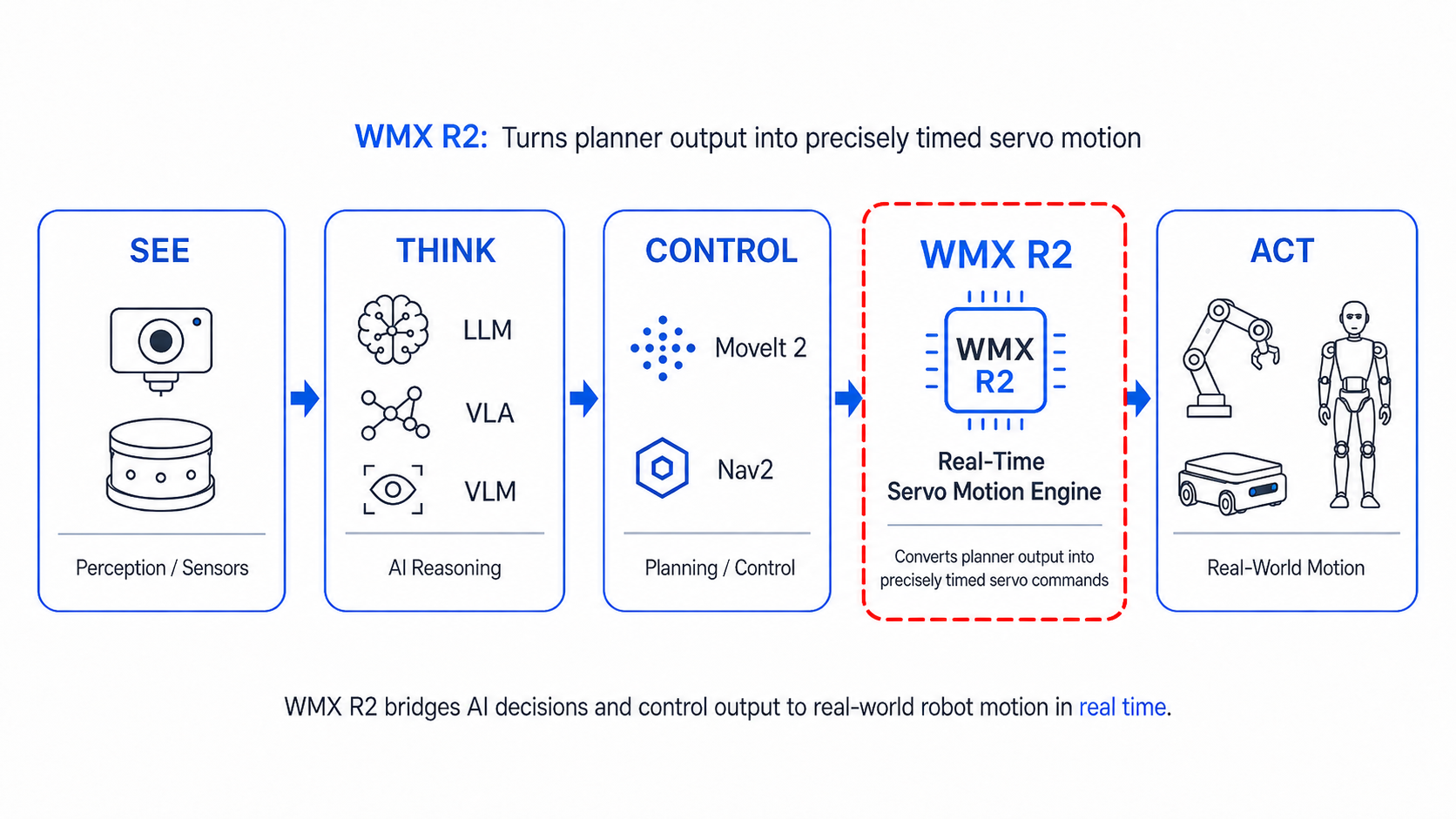
In robot and Physical AI applications, the camera finds the object and the AI model decides what to do within a few milliseconds. The arm then begins to move slightly later than it should, or less smoothly than the plan intended. Closing that gap between the decision and the movement is what our team has worked on for the past year.
WMX R2 is one solution built from two parts, a ROS 2 interface and the WMX motion engine, and the "R2" stands for *Real-time Robotics*. The ROS 2 interface connects to the planning and perception tools that robotics teams already build with, and the WMX engine drives the servos underneath it in real time. We began the work last year, and we have since shown the system at GTC 2026, at Automation World Korea 2026, at Intel Edge Day 2026 in Taiwan and at the Advantech World Partner Conference 2026 in Taiwan.
The step between planning and moving
Physical AI is usually described as three steps called See, Think and Act, in which the robot sees its surroundings through a camera, thinks about what to do using an AI model, and then acts by actually moving. As an industry we have put most of our energy into the seeing and the thinking, and much less into that final step.
Planning software such as MoveIt2 or Nav2 can work out a safe path for a robot within a few milliseconds. Turning that path into movement is a different job, because a servo drive expects a new command at a fixed interval, often once every millisecond, and each command has to arrive on time.
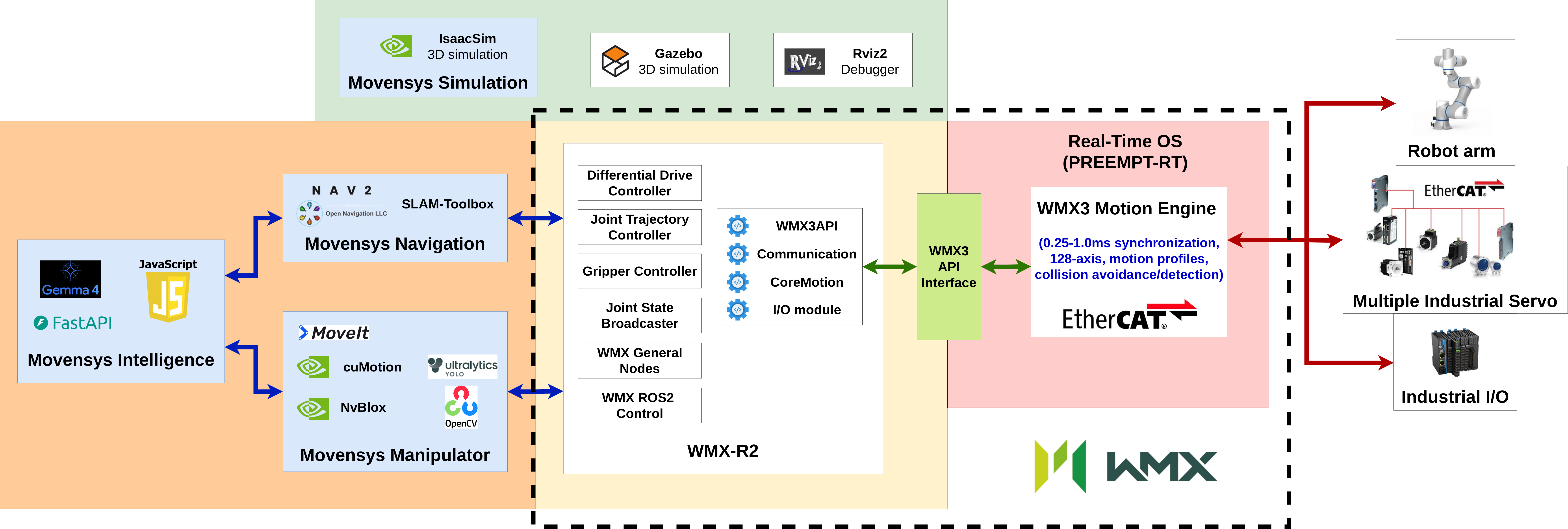
Because the engine works inside ROS 2 rather than beside it, WMX R2 also works with the open-source tools that robotics teams already use, including MoveIt2 for robot arms, Nav2 for mobile robots, ros2_control for hardware interfaces, NVIDIA Isaac Sim and Gazebo for simulation, NVIDIA Isaac ROS and Intel OpenVINO for perception, and YOLO for object detection. None of these tools had to be modified to work with WMX R2.
Running AI and motion control on one computer
Most systems handle this by sending the planned path over a network connection to a separate controller box. This works, but the extra trip adds a delay that cannot be recovered afterwards. We wanted the motion engine to run on the same computer as the AI, so that the plan becomes movement without ever leaving the machine.
The same software runs on standard industrial PCs, on Intel Panther Lake systems, and on NVIDIA Jetson boards. Keeping one version of the software for all three was a useful discipline, and writing the installation guide honestly for each platform found more real problems than our own tests did.
What we learned
Two lessons stand out from the past year. The first is to look at the worst case rather than the average, because a robot can behave well on average and still fail because of one late command. The second is that the last step matters as much as the first. Using an AI model is easy today, but making its decisions arrive accurately in the real world, on every cycle, is the hard part. That is what MOVENSYS has spent twenty-five years on.
WMX R2 was released on August 4, 2026. The accompanying documentation and source code are available below.
- Documentation: https://movensys.github.io/wmx-r2-doc/
- Source: https://github.com/movensys/wmx-r2
 Next
Next
