



NEWSROOM
NEWSROOM

News
News
[Money Today] Government Bets on ‘Physical AI’… Unveils Domestic Integrated Platform to Replace Foreign Factory Solutions
- 2026.04.13
- |
- 최고관리자
- |
- 2,466
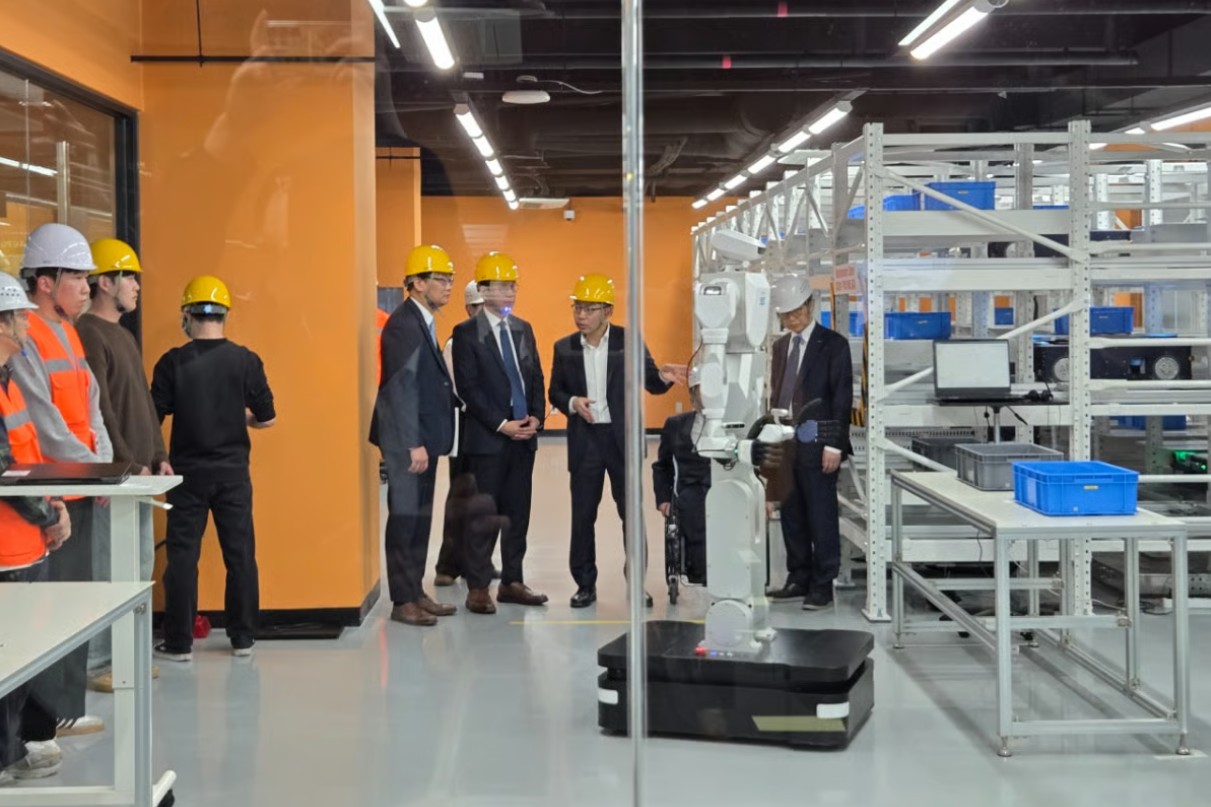
Deputy Prime Minister and Minister of Science and ICT Bae Kyung-hoon (sixth from the left) is conducting an on-site inspection of a demonstration lab at KAIST in Yuseong-gu, Daejeon. / Photo by Reporter Lee Chan-jong
The government has introduced a “Physical AI” strategy to reduce reliance on foreign solutions in manufacturing environments. It also unveiled, for the first time, a demonstration platform that integrates factory operation systems using domestic technologies. The plan is to advance manufacturing process automation by combining robots, sensors, controllers, and AI operating systems, and to link this to industrial competitiveness and exports.
On the 23rd, the Ministry of Science and ICT announced the “Strategy (Draft) for Securing Core Competitiveness in Physical AI,” and revealed a “Physical AI Integrated Platform” capable of replacing manufacturing factories that have relied on foreign solutions costing hundreds of millions of won with domestic technologies.
This strategy focuses on establishing a full-cycle system of “technology acquisition → demonstration → industrial expansion → global expansion” to connect Physical AI to industrial competitiveness. The Ministry of Science and ICT defined four key initiatives:
Development of three core foundational technologies
Securing manufacturing process automation technologies
Creating an ecosystem for the expansion of Physical AI
Establishing a collaborative framework among industry, academia, research institutes, and government
The three core foundational technologies include:
A general-purpose “robot foundation model” capable of autonomously planning tasks and performing long-term, high-precision operations like a human
A “world model” that generates large-scale training data and supports virtual experiments to ensure operation in real environments without errors or delays
A “computing platform” based on high-performance, low-power, low-latency AI semiconductors
The Ministry plans to immediately introduce and demonstrate these technologies, starting with key sectors such as logistics, agriculture, and disaster and safety.
It will also develop manufacturing process automation technologies to secure competitiveness in the manufacturing sector. The Ministry plans to comprehensively acquire sensor-based data, behavioral data, as well as real, virtual, and synthetic data. These technologies will first be applied to three key industries—automotive, precision manufacturing, and shipbuilding—and then expanded globally.
An ecosystem for the systematic expansion of Physical AI will also be created. The Ministry plans to support corporate growth by identifying and improving on-site regulations, attracting investment, and supporting overseas expansion. It will also establish a talent development system for Physical AI, ranging from master’s and PhD-level experts to field practitioners. Finally, it will bring together capabilities across ministries and establish cooperation frameworks among related associations and alliances.
To reduce dependence on foreign solutions in manufacturing environments, the Ministry of Science and ICT and the National IT Industry Promotion Agency carried out a “Physical AI pre-validation project” last year (September–December) through a supplementary budget, centered on Jeonbuk National University and KAIST (Korea Advanced Institute of Science and Technology).
On this day, Deputy Prime Minister and Minister Bae Kyung-hoon conducted an on-site inspection of the KAIST demonstration lab (Yuseong-gu, Daejeon), where a factory operation system integrating domestic technologies has been implemented, including optimization of factory scheduling and logistics operations.
The KAIST demonstration lab integrates technologies from domestic leading companies such as CANTOPS (sensors), Movensys (controllers), Airobot (robots), and MakinaRocks (AI data infrastructure), achieving 100% localization from the factory’s “brain (AI operating system)” to its “muscles (robots and equipment).”
In particular, the “AI factory manager (operation agent)” optimizes logistics and scheduling of real factories in real time through digital twin-based simulations, enabling even small and medium-sized enterprises to operate advanced factories without relying on foreign solutions.
The Ministry also listened to on-site feedback through a corporate roundtable on the same day. It plans to reflect the opinions discussed into the strategy (draft) and finalize and announce it at the next Science and Technology Ministers’ Meeting after consultations with relevant ministries.
Deputy Prime Minister and Minister Bae Kyung-hoon stated,
“The next three years are a golden time for Korea to mobilize its national capabilities to leap forward as a global leader in Physical AI,” and emphasized, “We must go beyond the stage of developing technologies by bringing together industry, academia, and research capabilities, and move toward the stage of transforming industries and expanding exports.”
Source: https://www.mt.co.kr/tech/2026/03/23/2026032310374727327
 Previous
 Next
Next
