



NEWSROOM
NEWSROOM

News
News
[MK Economy] Moving robots with a single PC: the company even Mitsubishi invested in
- 2026.10.08
- |
- 최고관리자
- |
- 29
Founded by Movensys Chairman Bernard Boo-Ho Yang, an MIT alumnus
Motion control refined over 30 years in semiconductor equipment
Now taking direct aim at the execution layer of robotics and physical AI
The machines inside a factory never stop moving. They pick up and transfer semiconductor wafers, and robot arms return to their positions. There is a device that directs each of these movements: the motion controller. Until now, this job has been handled by dedicated hardware. A separate control board is attached next to the equipment, and the motor axes are connected to it. The problem is scalability. To use one more axis, you have to replace the board or install a new one. The same goes for adding functions.
Movensys removes this board. It moves the work that hardware used to do into software running inside a computer. The company calls this Software-Defined Motion Control (SDMC), an approach in which software, not hardware, directs movement. If that sounds complicated, think of a mobile phone. With the old feature phones, changing functions meant buying a new device. With a smartphone, you just install an app and update it. That is the very analogy the company itself uses. In practice, with its flagship product WMX, adding axes or functions means adding a license instead of buying a new board.
Founded in Boston, expanded via Japan to Korea
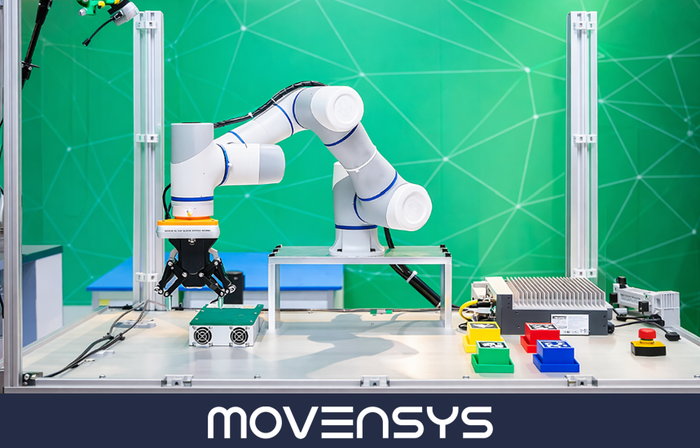
Movensys has won global customers with technology that runs robots from a single PC. (Movensys)
It all began with frustration in the lab. Founder and Board Chairman Bernard Boo-Ho Yang researched robot control in MIT's Department of Mechanical Engineering. Whenever he tried to load and run algorithms he had written on a robot, he kept hitting walls. Controllers at the time had closed, dedicated-hardware-centric architectures. Since users could only use the functions the manufacturer opened up, it was difficult for researchers to modify them as they wished. So he built the control functions in software instead. His experience studying theory and software at Kyoto University's Department of Applied Mathematics and Physics came into play here. Once the program that ran robots from a PC was working, representatives of Japanese companies visiting the lab lit up. He became convinced that this research tool could become a product that solved problems in factories.
In 1998, he co-founded the company with his academic advisor in Boston. Watching PC performance improve year after year, he believed software would eventually take over the domain of hardware. Later, after confirming demand at a Japanese robotics exhibition, he expanded the company's base to Japan. Meeting the demands of customers in Japan's exacting manufacturing sector, he refined the product. In 2014, he established a Korean subsidiary, timed with the growth of Korea's semiconductor equipment industry. The name Movensys combines the Latin word movens, meaning "moving," with "system."
The company has also attracted steady investment. In 2020, it secured funding from a domestic private equity firm, and in 2023, Japan's Mitsubishi Electric came on board as a strategic investor. It was not just money; the investment also brought along a global sales network.
A structure that earns more as customers sell more
What this reporter was most curious about was the business model. If it were a one-time software sale, growth would be limited. Movensys's answer is licensing. A license is supplied when WMX is installed on a customer's equipment, but it doesn't end there. Every time additional units of the same equipment model are produced and sold, a license goes along with each one. The company calls this a "pipeline revenue structure." Simply put, the more equipment its customers sell, the more Movensys's revenue grows. That makes expanding the number of models it is applied to and its customer base the top priority. When customers request it, the company also bundles the software with hardware such as industrial PCs.
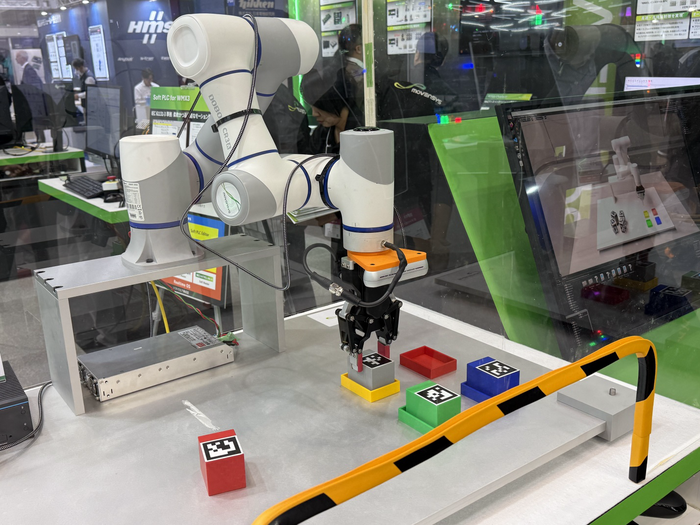
A demo applying WMX. (Courtesy of Movensys)
Its main arena is semiconductor equipment. Software-based motion control itself is a field that has long been explored overseas as well. So where is the competition decided? In consistently meeting the precision and stability that mass-production equipment demands. Something working once in the lab is different from it working all year round in a factory. Ultimately, technology must be paired with field experience. WMX synchronizes up to 128 axes in software on a single CPU. The related technologies are protected by registered patents in Korea and abroad.
The next card is WMX Ultra, a product aimed at advanced packaging such as HBM. In processes where multiple chips are stacked and bonded, even the slightest misalignment leads to defects. As thermocompression bonding becomes more advanced and hybrid bonding is introduced, equipment must move with even greater precision. The company, however, remains cautious. "Its future contribution must be confirmed through verification and adoption on customers' equipment," the company explained.
A single-PC demo at the Intel Summit
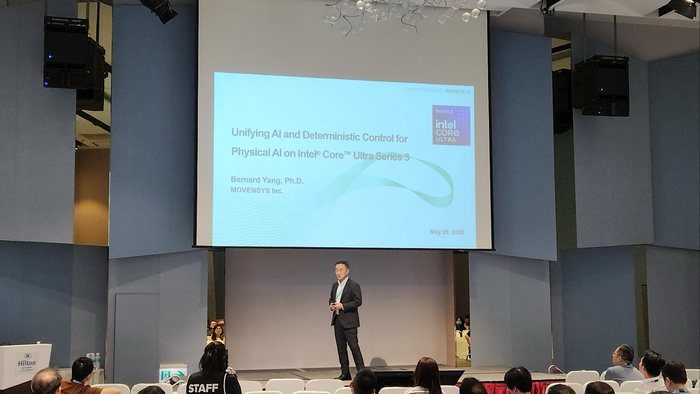
Movensys Chairman Bernard Boo-Ho Yang presenting at an Intel event in Taiwan in May 2026. (Courtesy of Movensys)
Where Movensys stands in physical AI, today's hot topic, is clear. The company divides physical AI into three stages: perception, decision, and execution. Movensys handles the last one, execution. Why is execution a problem? A robot that hits every target in simulation often jitters, falls out of sync, and stalls once it's placed on an actual line. The industry calls this the Sim2Real Gap, the performance gap between simulation and the real-world site. Chairman Bernard Boo-Ho Yang puts it vividly: "No matter how brilliant the brain, if the nervous system is weak, you'll end up clumsy."
Looking at the time scales makes it easy to understand. The time it takes AI to assess a situation and make a decision is typically 100 to 500 milliseconds. One millisecond is a thousandth of a second. But for robot joints to move smoothly without jitter, the control cycle must be kept at 0.5 to 1 millisecond. That means while the AI issues a single command like "go over there," the layer below has to recalculate how to drive the motors hundreds of times. Yet as the AI's command passes through an external controller and travels over the communication network to the robot, time leaks away bit by bit. That is why Chairman Bernard Boo-Ho Yang calls conventional hardware controllers a "black box" (a closed structure in which only the functions opened up by the manufacturer can be used).
The solution is simple: eliminate the stops in between. Run AI inference and robot control together inside a single industrial PC. Movensys unveiled this concept at the Intel Edge Solution Summit 2026, held in Taiwan on May 29. At Intel's official invitation, it hosted a dedicated session and a demo booth. It ran WMX on a PC equipped with Intel Core Ultra Series 3, and combined it with OpenVINO, Intel's AI inference optimization toolkit, and TCC technology, which coordinates the order of computations to meet timing requirements. The demo was a board game. A single PC visually read the positions of the dice and game pieces, then immediately generated a path for the robot arm within the same chip and moved the pieces. "The essential challenge of physical AI is how accurately you can translate decision data from a virtual environment into physical motion in the real world," Chairman Bernard Boo-Ho Yang said.
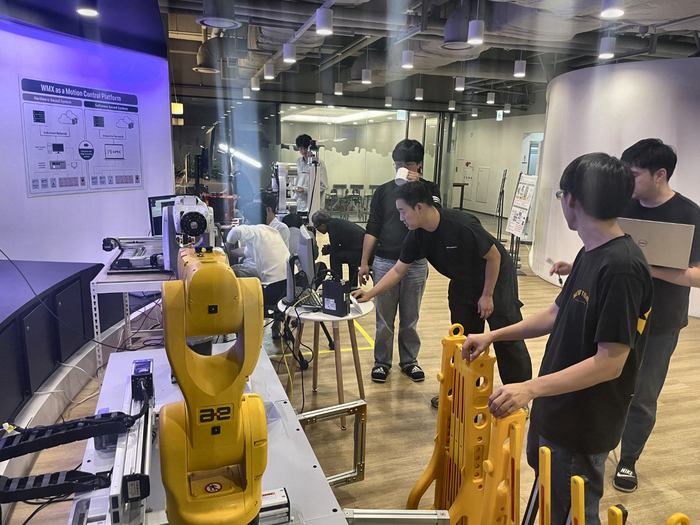
An engineer testing WMX applied to equipment. (Courtesy of Movensys)
The company has also put mechanisms in place to attract developers. Until now, robot control has been done in C-family languages while AI development has been done in Python, making the two difficult to connect. WMX supports C, C#, and Python. Its integration interface for ROS 2 (an open platform for robot software development), widely used in robotics, is free, while only the core engine is sold under license. In the R&D stage, users can run it free for up to six hours at a time, but using it in actual production requires payment. It's a design that lowers the barrier to entry while protecting the revenue-generating segment. The latest version, WMX3, is also connected to NVIDIA's robot simulation platform, Isaac Sim. The company has also launched Skylla WAVE, a mobile collaborative robot incorporating autonomous navigation from its subsidiary Skylla Robotics. Its target application is logistics automation at outsourced semiconductor assembly and test (OSAT) sites.
Overseas, it goes with partners. It has teamed up with Mitsubishi Electric in the motion control business and linked products and technology with Advantech. Since technology alone makes it hard to reach global customers, the approach is to layer its software onto the sales networks its partners already have. Movensys is also preparing for an IPO, with the timeline still being coordinated. The company sees the listing not as a goal but as a starting point: a springboard to bring the motion control platform it has refined for nearly 30 years in semiconductor equipment into the larger markets of robotics and physical AI.
Of course, the hurdles ahead are considerable. The first is the conservative manufacturing floor. Hardware-based control has been an iron rule of factory automation for decades. Few factories are willing to overhaul a line that is running well. Chairman Bernard Boo-Ho Yang himself acknowledges that "not all equipment can be replaced right away." In the end, the only way forward is to prove itself one step at a time, starting with segments that require both precision and speed.
The second is WMX Ultra. To enter HBM processes, it must pass verification on customer equipment, but it is still in development. The third is the developer ecosystem. The six-hour free policy has lowered the barrier, but how much of that will translate into actual license revenue remains to be seen. If Chairman Bernard Boo-Ho Yang's diagnosis is right that the battleground of physical AI is shifting from intelligence to execution, then Movensys is standing in a pretty good spot.
Source: PC 한 대로 로봇 움직이는 기술...미쓰비시도 투자한 ‘이 회사’
 Next
Next
